


Here it is: Tipp City Photographer’s Route 66 Journey Goes on the Auction Block
Silent Auction at the Tipp Center Benefits Tipp City Area Arts Council
Story and photos by Matt Bayman
TIPP CITY - On a pitch-black night in 2010, Tipp City resident Terry Glass climbed a fence in the Arizona desert to photograph an intriguing roadside billboard. A seasoned photographer, Glass was no stranger to chasing a shot. However…
“I started thinking to myself, ‘This is crazy. I don’t know anybody out here. I’m all by myself,’” Glass said. “I got back in the car pretty quick.”
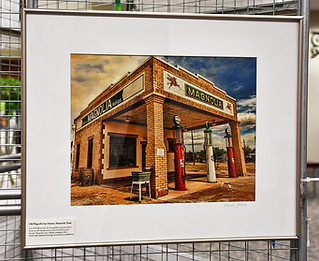
He got the shot. Now, 16 years later, the image of the Jack Rabbit Trading Post’s famous “Here It Is” sign is part of Glass’ Route 66 collection, and eight photographs from that collection are being sold through a silent auction at the Tipp Center. Glass and his wife, Jana, are charter members of the Tipp City Area Arts Council, and he offered to donate the photographs to the council. All proceeds from the auction go to the council, and bidding is open through Nov. 14.
The Mother Road
Glass’ fascination with Route 66 began in the early 1990s at a AAA presentation in Kettering. The highway had been decommissioned in 1985, and a wave of nostalgia for it was building across the country.
Around the same time, he read Michael Wallis’ book “Route 66: The Mother Road.” It focused less on pavement than on the people and businesses in the small towns the road strung together into a national highway.
“It was really about the lifestyle of the people, not just the buildings and the road, and I was fascinated with that,” Glass said.
The idea stayed with him for nearly two decades while he worked. Retirement in 2007 finally gave him the time. In 2010 and 2011 he drove the route in four segments, covering three of them alone at about 100 miles a day so he could stop whenever something caught his eye.
Jana joined him for the fourth leg, from Chicago to St. Louis.
“She loved it,” he said.
That stretch of Illinois remains his recommendation for Ohioans who want a taste of the road without driving all 2,400 miles.
“There’s a lot of it left that you can see—a lot of mom and pops,” he said.
Chasing icons
On his journeys out West, Glass went looking for the road’s legends: the Blue Whale of Catoosa, Oklahoma, Roy’s Motel and Cafe in Amboy, California, and the glowing neon of the Blue Swallow Motel in Tucumcari, New Mexico, which he also photographed. He spent nights in both of Route 66’s Wigwam Motels, in Holbrook, Arizona, and San Bernardino, California, where guests sleep in concrete teepees.
But what really draws his eye is wear. He cited wabi-sabi, the Japanese idea of finding beauty in imperfection and impermanence.
“Mostly I like distressed objects that have some beauty to them,” he said. “Just try to look for something in everyday observance that’s interesting, or you can make it interesting with the lighting or the angle or the composition.”



A lifelong lens
Glass picked up photography at age 12 from an uncle. For decades it meant family snapshots. In the late 1990s, he began taking it seriously as an art form.
“I never really intended to sell stuff, but I’ve accidentally sold stuff over the years,” he said.
His curiosity tends to turn into projects. In 2016, he set out to photograph all 21 of California’s Spanish missions, the chain begun in 1769 by Father Junipero Serra. Each morning he arrived before the gates opened to shoot the grounds in quiet early light. Then he worked his way inside to the chapels and gift shops.
By midday he was back on the road. He stopped at an In-N-Out Burger and drove the 30 or 40 miles to the next mission, about a day’s journey in Serra’s time. He photographed two missions a day for nearly two weeks, all in black and white.
There were other pursuits, too: the preserved ghost towns of Bodie, California, and Bannack, Montana, street photography in San Francisco shot almost entirely on an iPhone, and lately, cyanotype, a 19th-century process that turns watercolor paper and sunlight into blue-and-white prints.
“That’s the easy one for alternative processes,” he said.
Workshops have also taken him places he might never have found alone, including Anderson, Indiana’s restored Paramount Theatre.
“Even if you think you know a lot,” he said, “a lot of times they get you to places you might not normally get to by yourself.”
Back down the hall
For Glass, the Tipp Center exhibit is something of a homecoming.
He spent 39 years with A.O. Smith. In 2000, the company bought St. Louis motor maker Century Electric and needed more room. It moved into the former DAP building on North Third Street, which was remodeled into offices, and Glass worked there for his last seven years with the company. Today, the building is the Tipp Center, a business and event campus located at 855 N. 3rd St.
His old office, just down the hall from the exhibit area, now houses a massage business. He encourages anyone who hasn’t seen the building’s transformation to stop in.
“So many people don’t even know about it yet,” he said. “I tell people all the time, you just gotta go in there and just look around. It’s just beautiful.” The Center has won awards for its capacity.
The arts council was founded in 2010, the same year Glass first set out on Route 66. When he approached the council about donating his photography, Lynn Shirk-Terrell, the council’s nonprofit administrator and communications coordinator, suggested a solo exhibit at the Tipp Center with a public silent auction. It is Glass’ fifth one-person show of his Route 66 work.
In addition to the eight prints up for auction, two of Glass’ exhibition pieces will be donated to the council’s Permanent Art Collection, which is housed at the Tipp Center and open to the public during regular business hours, Monday-Friday.
The photographs can be viewed and bid on through Nov. 14. That day from 10 a.m. to 4 p.m., the council hosts A Holiday Affair, its popular annual craft, art and vendor show at the Tipp Center.
The Tipp City Area Arts Council is a 501(c)(3) nonprofit. Donations can be made through the Donate button at tippcityartscouncil.com or by check mailed to P.O. Box 74, Tipp City, OH 45371.
In all, Glass printed, matted and framed 45 Route 66 photographs. For him, the work behind them was never only about the pictures.
“Photography can be such a lifestyle, making you more observant, making you slow down, meet new people,” he said. “Being a curious person, I’ve just got more things I want to check into than I have time for.”