


AT LEFT: Lieutenant Commander Zachary Lansdowne, USN, a native of Greenville, Ohio.
AT RIGHT: Lansdowne was a Greenville native, who went down with his ship—America’s first rigid dirigible (an airship), USS Shenandoah (pictured here moored to its tower)—on September 3, 1925.
100 Years Ago: Greenville's Lt. Lansdowne - He Flew High and Fell Fast
By Judy Deeter - Images in the Public Domain
GREENVILLE - On the second floor of Greenville’s Garst Museum—tucked between rows of American military uniforms—there is a collection of things that once belonged to United States Navy Lieutenant Commander Zachary Lansdowne. The items tell the personal story of a public tragedy.
Lansdowne was a Greenville native, who went down with his ship—America’s first rigid dirigible (an airship), USS Shenandoah—on September 3, 1925. While there are many accounts of the crash of the Shenandoah, very few stories tell about Lansdowne’s personal life. The story of Lansdowne’s life is both endearing and enduring.
Early Life
Lansdowne was born in Greenville on December 1, 1888 as the third child James and Elizabeth Knox Lansdowne. His parents were well known in the town. His father, a graduate of Antioch College, was a cashier for the Exchange Bank of Greenville. His grandfather, Dr. Zachariah Lansdowne, had once been a town doctor (he moved to Kansas in 1876).
His mother, Elizabeth Knox Lansdowne, was the only daughter of prominent Greenville lawyer and Judge John Reily Knox. Knox, was an 1839 graduate of Miami University, a founder of Beta Theta Pi Fraternity, a member of the Miami University Board of Trustees, 1869-1898 and a partner in the Greenville law firm of Knox, Martz and Rupe. His Uncle Harry Knox (his mother’s brother) was a Navy Rear Admiral.
When young Zachary was ten in October 1899, his father died of tuberculosis, leaving his mother to care for he and older brothers John Knox (known as “Knox”) and Harry. She never remarried.
An article by Carol Mikesell in the December 28, 1976 edition of The Early Bird says:
“As a young boy, Lansdowne was considered precocious. He seemed to enjoy all the things other young boys did. As a student in the Greenville school system, he did extremely well in mathematics. At home, he showed a great interest in the Navy, probably because his mother, Elizabeth, told him some fantastic stories about his Uncle, Rear Admiral Knox.”
Almost everyone in Greenville seemed to know “Zach” Lansdowne.

Lieutenant Commander Zachary Lansdowne home in Greenville, Ohio. (Public Domain)
Naval Beginnings
Lansdowne’s military career began with his appointment to the Naval Academy at Annapolis in September 1905, when he was just 16 (a high school junior). He received his appointment through U.S. Congressman Harvey Cable Garber of Ohio’s 4th District.
Zachary’s mother had worried that her son would not be appointed because Congressman Garber was a Democrat and the Lansdowne family was Republican. The Congressman, however, remembered an “act of kindness” given to him as a boy by Zachary’s father and did not hesitate to make the Annapolis appointment.
Lansdowne graduated with the class of 1909. After graduation, he served two years on the battleship Virginia, five years on the destroyer McCall, then did recruiting work and was in charge of the hydrographic office in Cleveland, Ohio.
Family and Flight
Just prior to World War I, he married Ellen (MacKinnon/Mackinson) from Wisconsin. Although he had an interest in dirigibles, both his wife and mother were opposed to his flying, so he worked on earthly projects.
In 1916, Ellen died shortly after giving birth to their son, Falkland. To help ease the grief of his wife’s death, Lansdowne pursued his interest in flight.
He studied aeronautics at Pensacola, Florida, and in 1917 he was the Naval Representative to the Goodyear Tire and Rubber Company. During World War I, he went to England to learn about dirigibles, lighter-than-air aircraft that stayed afloat by gas of lesser density than the atmosphere. Dirigibles were the forerunners of today’s blimp.
Crossing the Atlantic
According to a biographical sketch from Arlington National Cemetery:
“In July 1919, Lieutenant Commander Lansdowne served on board the British rigid airship R-34 during its historic non-stop flight across the Atlantic to the United States. (The R-34 was the first airship to fly across the Atlantic from East to West. Lansdowne, the American representative on board, is credited as being the first American to cross the Atlantic Ocean by air.)”
Service followed at the Navy Department in Akron, Ohio, and as a White House aide. He was Assistant Naval Attache in Germany in 1922–23 during which time his duties involved negotiations that resulted in the construction of USS Los Angeles (ZR-3), the Navy’s second rigid ship.
About 1920, he began dating again. He married Margaret S. K. Ross (known as Betsy Ross) in Washington, D.C. in December 1921. They were soon the parents of a baby girl named Margaret.
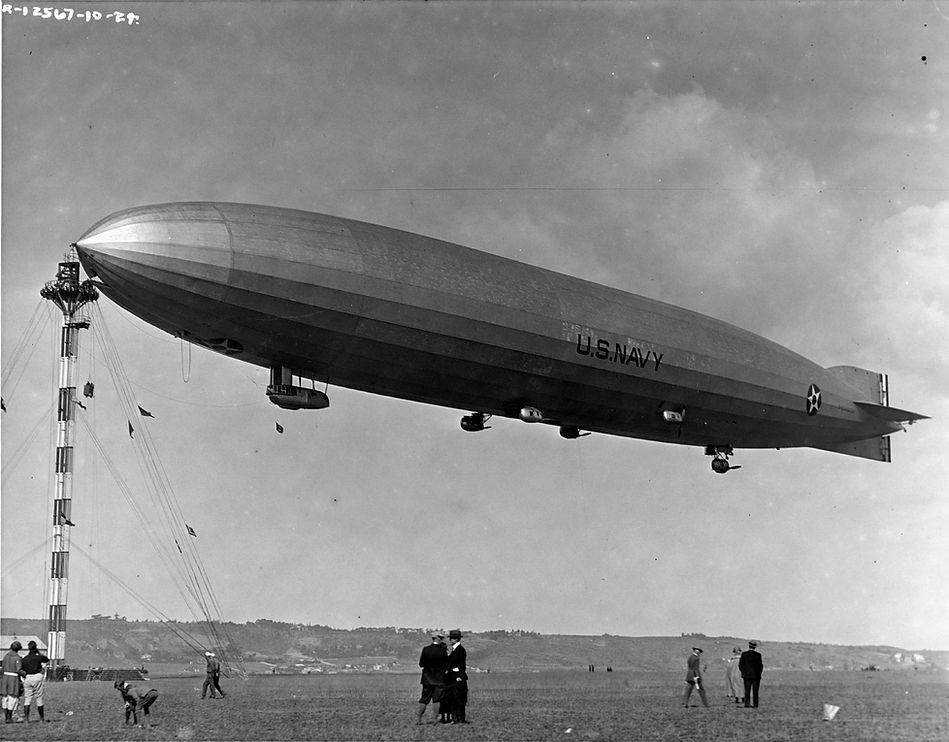
USS Shenandoah moored at NAS San Diego. (Public Domain)
Command of the Shenandoah
In early 1924, Lansdowne was given command of the dirigible USS Shenandoah, whose name meant “Daughter of the Stars.” According to the Dictionary of American Naval Fighting Ships, she was the first rigid airship designed and built by the U.S. Navy.
On June 3, 1924, under Lansdowne’s command, the Shenandoah made history as the first airship to moor with a ship at sea. Later that year, she completed the first flight from the Atlantic to the Pacific across the continental United States, flying directly over Greenville.
Local newspapers captured the excitement of Lansdowne’s radio message to his mother, who was at home on East Third Street, and townspeople’s jubilation at the sight of the massive airship above their town.
Tragedy in the Skies
By summer 1925, the Navy ordered the Shenandoah to appear at 40 state fairs and cities across the Midwest. Lansdowne strongly objected to flying through storm-prone areas but was overruled.
On September 2, 1925, the airship lifted off. By early morning the next day, over Noble County, Ohio, the dirigible broke apart in violent storm conditions.
Lansdowne and 13 crew members were killed. The wreckage drew thousands of spectators and souvenir hunters. Survivors credited the use of helium, rather than hydrogen, with saving their lives.

According to Wikipedia: On 2 September 1925, Shenandoah departed Lakehurst on a promotional flight to the Midwest that would include flyovers of 40 cities and visits to state fairs. Testing of a new mooring mast at Dearborn, Michigan, was included in the schedule. While passing through an area of thunderstorms and turbulence over Ohio early in the morning of 3 September, during its 57th flight,[2] the Shenandoah was caught in a violent updraft that carried the ship beyond the pressure limits of its gas bags. The turbulence tore the airship apart, and it crashed in three main pieces near Caldwell, Ohio. Fourteen crew members, including Commander Zachary Lansdowne, were killed.

Legacy
Lansdowne was buried at Arlington National Cemetery, with simultaneous services held in Greenville. His death sparked national controversy, with his widow and family friend Colonel Billy Mitchell publicly accusing the government of forcing unnecessary flights for publicity.
His story lived on—in a 1955 film, in naval history, and even in the christening of the destroyer USS Lansdowne during World War II, remembered as the “Lucky L.”
Zachary Lansdowne’s life was cut short, but his legacy endures. As the last line of his Arlington biography reminds us:
“There is an old saying that ‘a life lived well will be remembered forever.’ Zachary Lansdowne lived well; he should be remembered forever.”

United States Navy board investigating the Shenandoah airship crash.

Overview of the first of the three crash sites of USS Shenandoah, a US Navy airship that broke apart over Noble County, Ohio and crashed in pieces in 1925. The site is located on the western side of Township Road 112 (Shenandoah Road) in far southern Buffalo Township, about four miles north of the Interstate 77 interchange at Belle Valley. In 1989, the three crash sites were designated a historic district and listed on the National Register of Historic Places.
The Wreck of the Shenandoah was written by Vernon Dalhart and Carson Robison.